
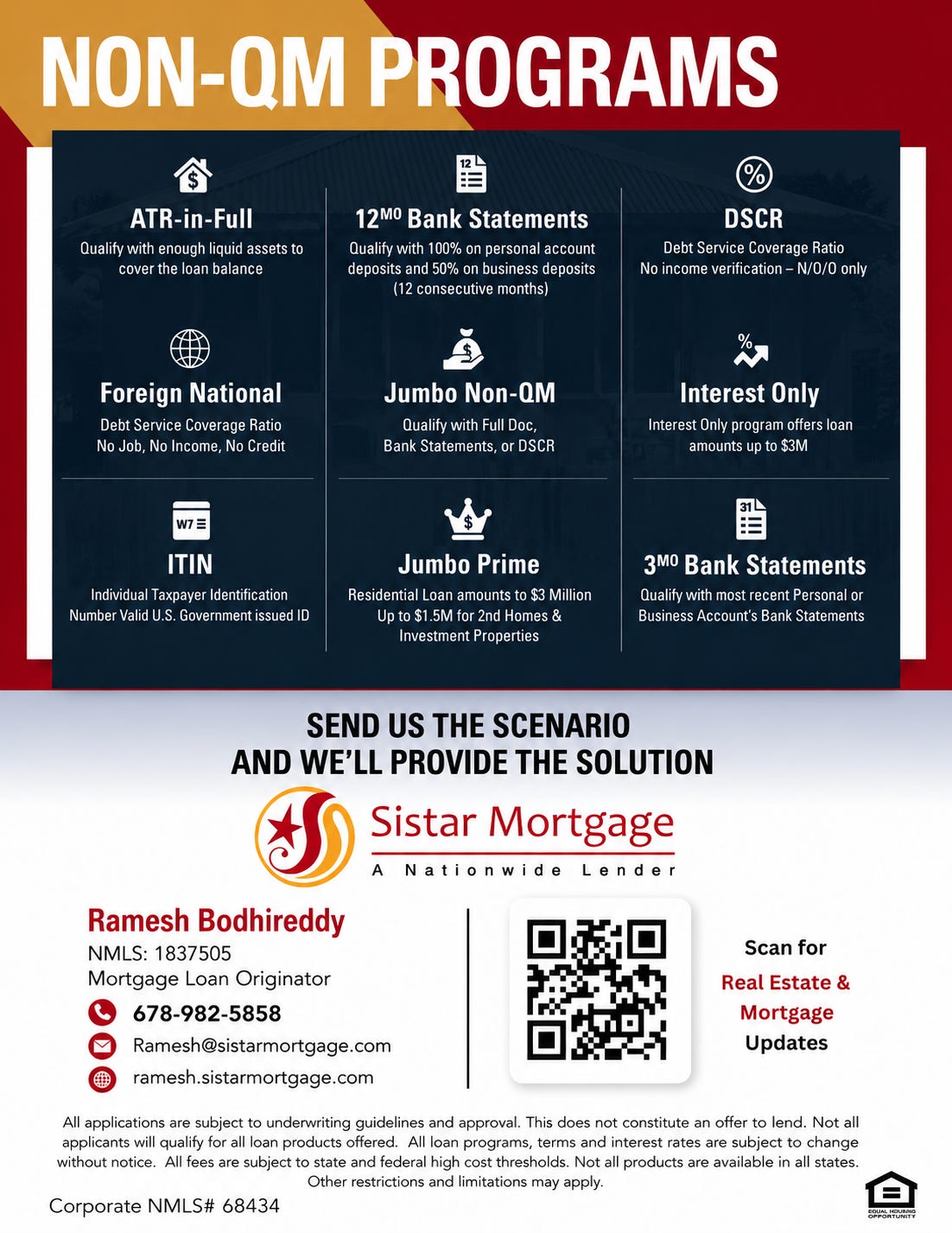
Eight Non-QM Programs!
Deals other Lenders Walk Away From!

A buyer with strong assets, real income, and a solid down payment gets a flat “no” from a traditional bank or lender -not because they’re a bad credit risk, but because their financial life doesn’t fit neatly into a W-2 and two years of tax returns.
That’s the entire reason Non-QM (non-qualified mortgage) lending exists. These are full documentation-flexible loan programs designed for real borrowers: self-employed founders, real estate investors, retirees living off assets, foreign nationals buying U.S. property, and high-net-worth buyers whose income doesn’t show up the way an underwriter’s checklist expects.
Below, I’m walking through eight Non-QM programs one at a time, with a realistic scenario for each, so you can see exactly who they’re built for.
1. ATR-in-Full: When Assets Speak Louder Than Income
The idea: Ability-to-Repay is demonstrated using liquid assets sufficient to cover the loan balance - not pay stubs.
Who it’s for: Borrowers sitting on substantial liquid wealth (investments, savings, brokerage accounts) but with little or no traditional income - often retirees or recently sold-business owners.
Scenario: A 64-year-old retiree sold her business two years ago and now lives off a diversified investment portfolio worth $2.1 million. She wants to buy a $650,000 condo in Florida but has no W-2, no recent tax return showing earned income, and her 1099-DIV income alone wouldn’t satisfy a conventional debt-to-income calculation. With ATR-in-Full, her liquid assets - verified and sufficient to cover the loan balance -become the qualification basis. No income statements required.
Why it matters: This program exists because “no income” and “no ability to repay” are not the same thing. Asset-rich, income-light borrowers are some of the safest loans in the building - they just don’t fit a traditional model.
2. 12-Month Bank Statements: Built for the Self-Employed
The idea: Qualify using 12 consecutive months of bank statements - 100% of personal account deposits and 50% of business account deposits count toward qualifying income.
Who it’s for: Self-employed borrowers whose tax returns show heavy write-offs and deductions, making their “official” taxable income look far smaller than their actual cash flow.
Scenario: A general contractor nets roughly $180,000 a year in real cash flow, but after legitimate business deductions, his tax returns show closer to $60,000 in taxable income - not enough to qualify for the $550,000 home he wants under conventional DTI rules. A 12-month bank statement program looks at what actually moved through his accounts, not what his accountant minimized for tax purposes.
Why it matters: This is arguably the single most-used Non-QM product, because it’s purpose-built for the exact borrower the tax code rewards for minimizing income - which conventional underwriting then penalizes.
3. DSCR: The Investor’s Loan (No Personal Income, No Problem)
The idea: Debt Service Coverage Ratio loans qualify based on the property’s rental income covering its own debt - not the borrower’s personal income at all. Strictly non-owner-occupied (N/O/O).
Who it’s for: Real estate investors building a rental portfolio, especially those who already have several mortgages and don’t want their personal income scrutinized property-by-property.
Scenario: An investor already owns four rental properties and wants to buy a fifth - a duplex renting for $3,200/month against a projected mortgage payment of $2,400. Conventional lenders would want to see this borrower’s full personal income and count all existing mortgage debt against her DTI, likely capping her out. A DSCR loan instead asks one question: does the property’s rent cover its own payment? Here, the answer is yes (DSCR of 1.33), and the loan qualifies on the asset’s merits.
Why it matters: DSCR loans let investors scale a portfolio based on property performance, not personal W-2 ceilings - which is exactly how professional real estate investing works in practice.
4. Foreign National: Qualifying Without a U.S. Credit File
The idea: Qualification via DSCR (no job, no income, no U.S. credit history required) for buyers who are not U.S. citizens or residents.
Who it’s for: International buyers purchasing U.S. investment property who have no U.S. credit footprint at all.
Scenario: A business owner based in São Paulo wants to purchase a $900,000 short-term rental property in Orlando as an investment. She has excellent financial standing in Brazil but no U.S. Social Security number, no U.S. credit score, and no U.S. tax returns - all things a conventional lender requires. Because this program qualifies on the property’s rental income rather than the borrower’s personal credit and income history, her lack of a U.S. financial footprint is no longer a barrier.
Why it matters: This opens U.S. real estate to a huge pool of international capital that would otherwise be locked out simply for lacking a domestic credit file - not because of any actual credit risk.
5. Jumbo Non-QM: Flexibility at the High End
The idea: Jumbo loan amounts qualified through Full Doc, Bank Statements, or DSCR -whichever fits the borrower’s actual financial picture.
Who it’s for: High-balance borrowers whose loan size exceeds conforming limits and whose income situation also doesn’t fit a standard box.
Scenario: A tech consultant earns $400,000 a year through a mix of 1099 contracts and equity payouts, and wants to buy a $1.4 million home. The loan amount alone pushes this into jumbo territory, and the income’s irregular structure complicates standard jumbo underwriting. Jumbo Non-QM lets the file be built around whichever qualification path - bank statements, full documentation, or DSCR if it’s an investment purchase - actually reflects how this borrower gets paid.
Why it matters: Jumbo borrowers are disproportionately likely to have complex income (business owners, executives with equity comp), so pairing jumbo loan sizes with Non-QM flexibility solves two problems with one product.
6. Interest Only: Maximizing Cash Flow Strategy
The idea: Interest-only payment structure on loan amounts up to $3 million.
Who it’s for: Sophisticated borrowers - often investors or high-net-worth buyers -who have a specific cash-flow or investment strategy and don’t want capital tied up in principal paydown.
Scenario: A borrower purchasing a $2.5 million second home wants to keep more cash deployed in their investment portfolio rather than building equity through forced principal payments. An interest-only structure lowers the monthly payment relative to a fully amortizing loan, freeing up cash flow that the borrower can deploy elsewhere, with the understanding that principal isn’t being reduced during the interest-only period.
Why it matters: This isn’t about affordability - it’s a deliberate financial strategy for borrowers who can put their capital to higher use elsewhere and want the mortgage structured accordingly.
7. Jumbo Prime: When the Numbers Are Strong, Just Big
The idea: Loan amounts up to $3 million on primary residences, and up to $1.5 million on second homes and investment properties.
Who it’s for: Borrowers with strong, well-documented financial profiles who simply need a loan size beyond conforming limits.
Scenario: A corporate executive with excellent credit, stable W-2 income, and a healthy down payment wants to buy a $2.8 million primary residence. Nothing about this borrower is complicated - the file just needs a jumbo-sized program with prime-level terms to match the borrower’s strong profile.
Why it matters: Not every Non-QM borrower has messy income - sometimes the “non-conforming” piece is purely the loan size, and Jumbo Prime keeps the underwriting straightforward while accommodating bigger numbers.
8. 3-Month Bank Statements: For Recently Changed or Seasonal Income
The idea: Qualify using just the most recent 3 months of personal or business bank statements.
Who it’s for: Self-employed borrowers with strong, recent cash flow but a shorter operating history, or those who don’t want a full 12-month lookback.
Scenario: A borrower launched a new consulting practice eight months ago after leaving a corporate job. The business is already generating strong, consistent deposits, but a 12-month bank statement program would require history she doesn’t have yet, and a conventional loan would want two full years of self-employment tax returns. A 3-month bank statement program looks at her most recent, most relevant performance - not a multi-year history that doesn’t yet exist.
Why it matters: Income trajectories matter as much as income history. This program is built for borrowers whose financial picture today is the most accurate one — not the one from two years ago.
Plus: ITIN Loans for Borrowers Without a Social Security Number
The idea: Qualification using an Individual Taxpayer Identification Number and a valid U.S. government-issued ID - no Social Security number required.
Who it’s for: Borrowers who are not eligible for a Social Security number but are otherwise documented U.S. taxpayers.
Scenario: A borrower has lived and worked in the U.S. for years, files taxes annually using an ITIN, and has built solid credit and savings- but lacks the Social Security number conventional loans require. An ITIN loan qualifies him using the documentation he actually has, rather than excluding him based on a number he was never issued.
The Common Thread
None of these programs exist to lower the bar on risk - they exist to widen the definition of qualification beyond “W-2 plus tax returns plus SSN.” Strong borrowers come in more shapes than the conventional mortgage box allows for, and Non-QM is simply the toolkit built to underwrite them on the merits of their actual financial picture.
Ramesh Bodhireddy Mortgage Loan Originator | NMLS: 1837505| Sistar Mortgage - A Nationwide Lender 678-982-5858 | Ramesh@sistarmortgage.com | ramesh.sistarmortgage.com
All applications are subject to underwriting guidelines and approval. This does not constitute an offer to lend. Not all applicants will qualify for all loan products offered. All loan programs, terms, and interest rates are subject to change without notice. All fees are subject to state and federal high cost thresholds. Not all products are available in all states. Other restrictions and limitations may apply. Corporate NMLS# 68434. Equal Housing Opportunity.